
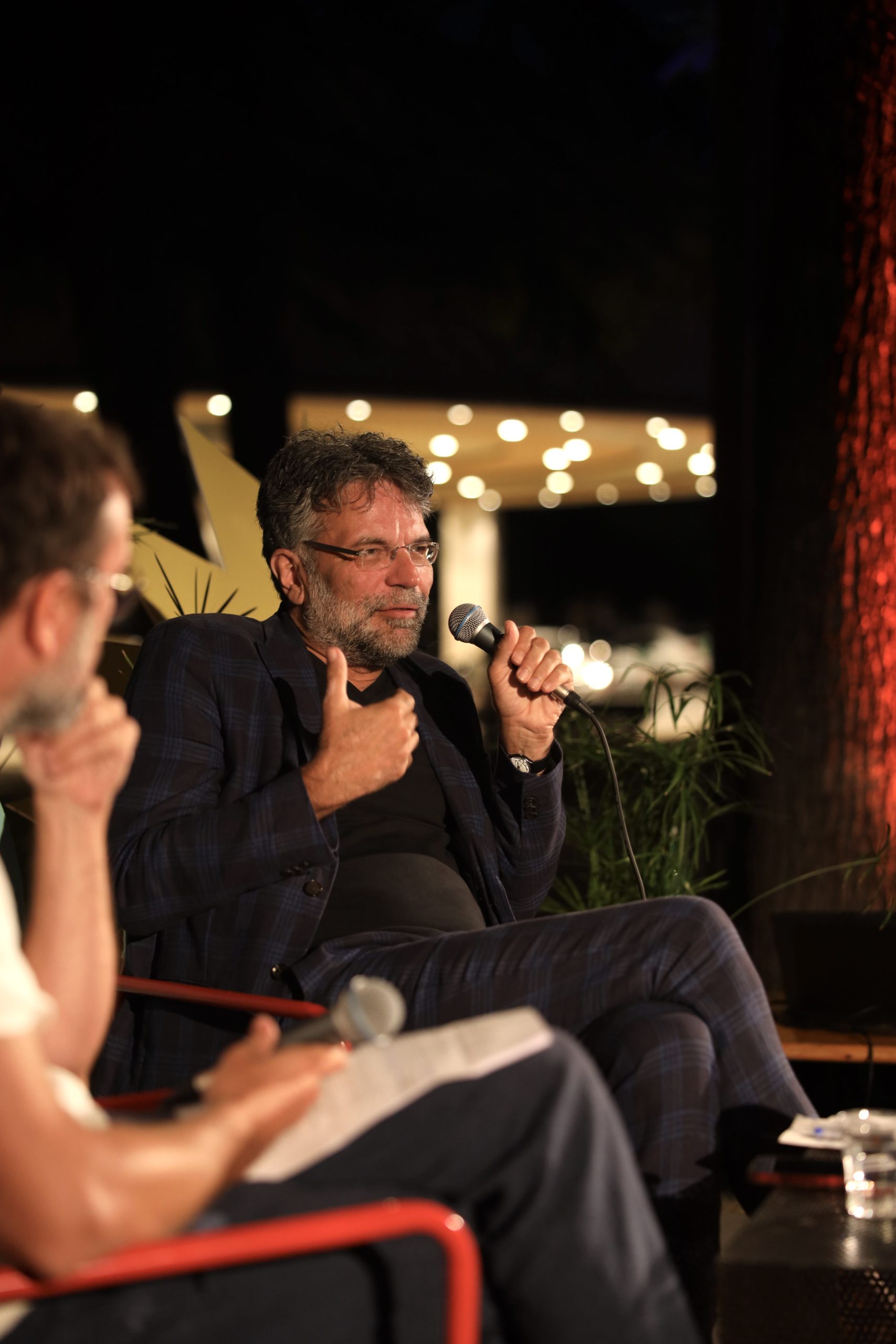
This edition of Mesto Knjige opened with Dušan Šarotar’s follow-up to Srečko Kosovel’s Manifest Mehanikom, written a century ago. Šarotar stated that “A manifesto is always a manifesto of a certain space and a certain time,” but in recent years the art world seems particularly concerned with the problem of historicity and temporality. More and more questions are being raised about fractured temporality, about an increasingly disjointed and conflicting political and economic time, and about the actuality of the concepts of events and grand narratives. What, in your opinion, is the function of time in contemporary art philosophy?
The manifesto is a genre proper to avantgardism, and both belong to a specific period of history: a moment of progress, when the majority of the people of a given society are convinced that they – or their children – will see a better tomorrow. A century (or more) ago, avantgardism was hegemonic in the arts. One could not only be an avantgardist; one had to. As Clement Greenberg remarks, every artist at that time had to go through an avantgardist period in order to achieve the maturity of their work.
This feeling of progress is of course completely absent today. And it cannot be revived by manifestos, since (to paraphrase a remark by Marcel Mauss on the magician) an avantgardist is not the one who wants to be one. Since we live in a “society of decline” (“Abstiegsgesellschaft”, the concept introduced by sociologist Oliver Nachtwey), almost nobody sees a better tomorrow. Since we lack progress, it is not possible to surpass other styles by avantgardism. Therefore what we see in the arts today is an arbitrary coexistence of styles, just like in the time of the historicism of Wiener Ringstrasse – none of theses styles being able to let the others look outdated. The artist’s desire to push art forward has to cope today with a general backwards move in the social field.
The split between contemporaneity and the future was one of the central themes of the conversation with Georgi Gospodinov, another of this edition’s guests. According to him, the problem with modernity is that it promises a future that never arrives, while we live in a blocked present. I refer back here to Osborne and Tafuri, according to whom the moment of crisis has become part of the structure, an endless process of transition, and that the state of permanent crisis of capital has spilled over into art. As a philosopher with experience in the field of art, would you agree with this statement?
The stagnation is real. Yet it is not modernity’s fault that its promises could not become true. The blockade has arrived with postmodernity. Postmodernity is the ideological accomplice of economic neoliberalism and jointly responsible for all the backlashes it brought about for economic, social and cultural life.
Remaining on the subject of the avant-garde, I would like to move on to negativity, a theme very dear to Hegelians. In a context endowed with an increasing obsession with engagement, ethics, and utility, can useless, negative, or purely experimental art still have value? Paradoxically, can an inventive form of negation, a form of experimental autonomy, contribute to politics?
As an Althusserian Marxist, I am strictly against using the notion of “negativity” for describing struggles or emancipatory efforts. If one does so, it reminds me of songwriter Wolf Biermann’s interlude “Oh Gott, lass du den Kommunismus siegen” (“Oh God, let communism prevail”). Recurring to negativity means to invoke a transcendent, second power, outside the material order of things. Instead, one must focus on the material forces and the overdetermined conditions of change. As Italian philosopher Lucio Colletti has pointed out, social struggles must be conceived of in terms of Kant’s “Realrepugnanz” (“repugnance in the real”), an opposition of positive forces, without contradiction, and not in terms of Hegelian negation and contradiction. For example, what you mention, the apparent “uselessness” of art, just like idleness in everyday life, is all but negative: it consists of material entities. It consumes lifetime, objects, money etc. Such “waste” in the sense of Bataille’s “negative economy” is not nothing, but a Kantian “negative quantity”.
But you are fully right: the subjection of art to all kinds of political agenda in the last decades has actually de-politicized the arts. It now only preaches exclusively to the already convinced, since it is incapable of attracting interest from anybody else. Its aesthetic value does not exceed its political content which one finds explained in the catalogue. Whereas a few decades ago people lamented the fact that art required so much explanation, one can today notice that in return it does not anymore require much observation.
Actually, as Jacques Rancière has rightly pointed out, it is precisely experiences of idleness and uselsessness (to quote his example: workers looking out of a palace window for the first time) that bring about aesthetic pleasure as well as an emancipatory feeling of sovereignty. An autonomous art that demonstrates that it does not serve any foreign purpose but its own is able to give people the idea that they, too, need not always subject themselves to heteronomous purposes.
In the critical discourse on contemporary art, I’ve noted an interesting parallel between your concept of interpassivity and Claire Bishop’s critique of participatory art, where she sees involvement and delegation as a masking of the status quo and existing power imbalances. As an intellectual who has actively dealt with these issues, do you believe that participation in art can truly be emancipatory or a vehicle for social criticism, or is it rather a continuation of the capitalist logic of “experience” and the increasingly widespread experience economy?
The obvious malaise of participatory – as well as interactive – arts stems from the fact they are the enactments of old, obsolete theories; such as Bertolt Brecht’s radio theory from the 1920ies, or Umberto Eco’s notion of the “open artwork” from the 1960ies. The basic mistake of these theories consists in the double assumption (1) that a one-directional relation between sender and receiver, or artist and public, constituted a hierarchy, and (2) that just observing or receiving would be mere passivity. Starting from these assumptions, the followers of these theories conclude that “activating” the audience by involving them in the production or sending process would liberate them politically and enhance their aesthetic pleasure. But this is all not true: the sender is not always the master, and the receiver is not necessarily a slave (just think, for example, of a letter of request, or of a plea for clemency). And a pure observer is not at all passive. The observer can play an eminently active and creative role just by critically observing and reading the artwork in different ways, “against the grain” etc. (a fact that Stuart Hall has pointed out). Whereas the observer’s creative possibilities in participatory and interactive art usually turn out to be actually quite limited – mostly nothing more than just a selection between pre-determined choices. And after all, as the theory of interpassivity has demonstrated, observers often do not only not want to be involved in the artistic production, but also not even in the consumption of the artwork. Instead, they prefer to establish an appearance of consumption, for example by just downloading a movie (without ever watching it) or by scanning a book (without reading it). These are small rebellions and attempts to get at a distance from the expected. And still they allow their agents to enjoy a certain contact with culture. This is just like in economy, where it is not the working participants, but actually the silent, idle shareholders who profit from the production.
With the advent of new media and the horizontal flow of information, content, and images available to everyone, how would you imagine a truly critical relationship between philosophy, art, and media theory in today’s context? Since participation, even in the wake of relational aesthetics, implies an increasingly less critical confrontation from all parties involved, can we speak of a depoliticization of participation, or of new conditions of spectatorship or interpassivity?
You are right. Participation is a thorough de-politicization of art. Since it attempts to depict a better, truer life in the small scale of art, within the worse, more false life of the whole. This is, as Adorno has taught, the wrong move. Art that has been really politically effective has always worked the other way round: it “painted the devil on the wall”, operated with cynical over-affirmation (e. g. John Heartfield “Hurray! The Butter is all gone!”) and paradoxical intervention (e. g. Christoph Schlingensief’s installation “Please do love Austria!”). Only such a type of art is able to shatter observers out of their comfort zone.
My introduction of the concept of interpassivity however was not a suggestion for an alternative artistic strategy. It was, in the first place, a theoretical attempt aiming at clearing the artist’s heads and at liberating them from the predominant ideologies of interactivity and participation which posed a serious threat to the artistic production: since they hindered the artists to understand what actually was the best part of their work.
In your books, you have repeatedly explored the so-called “illusions without subjects”, those illusions that no one shares individually but that function socially. However, your work has also underlined the importance of reevaluating these cultural illusions as a playful experience and as a possibility for structuring and organizing enjoyment. Could you elaborate on that?
The pleasure of art obviously stems from a certain “as if”, an illusion which is not ours. Take trompe-l’oeil paintings, for example: over the painting of the landscape appears to lie a layer of broken glass. But of course, we know immediately that this is not real glass, but just another fine proof of the painter’s brilliance. We then may say something like “Oh, how nice, one could have believed…” We love the illusion, but only under the condition that it is not our illusion.
The same “anonymous” illusion which never is ours is at work in politeness and civilized behaviour. In public space we attempt to appear as if we were a bit better – more elegant, more generous, more accomodating – than we really are. Of course, as Immanuel Kant has remarked, nobody falls for this illusion. Yet its performance still has positive material effects on our lives. Now after 1968 we have indulged in an ethics of authenticity and being oneself and not playing some “alienating” role. Yet, as Richard Sennett has pointed out, civilized behaviour is precisely the opposite: it means not bothering the other with one’s private whimsies and one’s silly self. This quality is not only more pleasant, allowing us to better get along with others in public interaction. It is also what qualifies us as political citizens. Since only by leaving our private issues behind we become able to join forces with others that are different from us but share the same political interests.
One last question, this one about comedy and your most recent publication, Das Lachen der Ungetäuschten. You’ve observed several times how tragedy and comedy work within two different types of illusion and observer: tragedy with faith and the omniscient superego [disillusioned observer], comedy with belief and the naive observer. At the end of your event, you stated that the attitude of naive observers, those who are able to recognize and enjoy the comedic aspects of reality as fiction, can reveal unexpected results, or the occurrence of something surprising even against all odds. Can you tell us more about this process, about the importance of comedy in— if you’ll pardon the pun—manifesting something?
Many commentators have tried to locate comedy’s sources of amusement in some failure: some funny mishap or mischief, or failure to live up to one’s exaggerated self-image etc. Even Lacanians have fallen to the temptation of recurring here to some lack. Yet comedy’s key point is success. Comedy’s heroes and heroines succeed in what they attempted, against all odds. When they for example want love, they get it – sometimes with the little twist that they get even more of it, surplus-love, as it were: not only a husband and a lover, but a husband, a lover and even another lover, for example, in Ernst Lubitsch’s To Be or Not to Be; or not only one wonderful wife, but even two of them, in Jack Conway’s Libeled Lady. The interesting point for me is that in many comedies the key characters have to deceive other characters – by pretending, for example, that they loved them. In a first stage the others fall for this deception. As spectators, we team up with the “knaves” and laugh about the fools – which are in fact nothing else than the spectators of a “theater on stage” that comedy regularily produces. They are embodiments of Mannoni’s naive observer, since they always believe what they see. Yet the real funny thing occurs at a second stage of comedy: when the knaves all of a sudden discover that what they believed to fake is actually true. Their fake love turns out to be true love etc. Now we spectators, without further ado, change camp and laugh, with the fools, about the knaves. Comedy’s plausibility and truth lie here in the underlying mechanisms that psychoanalytic theory has discovered: counter-transference and projective identification. Quite often we can not fully escape the illusions that we stage; when we act as if we were tired, we may well become tired; when we act politely, our sadness may disappear, etc. Like many people in real life, comedy’s characters find themselves caught up in the illusion of others.
However, the fact that fake, purely symbolic action in comedy produces real effects is precisely what anthropologists have called “symbolic efficiency” – the very mechanism that all magic is about and which is the source of the “uncanny” in the arts as well as in life. When Freud’s “Rat man” puts a curse on some other gentleman, and this other man dies soon after, this is an uncanny experience for the patient. Such “successes” are not pleasant for adult people, since they bring back infantile illusions that we have overcome when we groew up. Due to this overcoming, the originally pleasant, or protective things that once assured us of our alleged infantile omnipotence have now become sources of anxiety. Comedy’s typical successes mostly dwell on these manifestations of uncanny “impossibilities” – just think of the doubles, the doublegaengers and the repetitions that characterize many comedy plots, or the beforementioned surplus-successes. My claim is that the very affective energy that comedy allows us to laugh off is gained and accumulated via the powerful quality of uncanniness. Comedy’s trick is that it turns this unpleasant force into joyful amusement by transposing the “weight” of uncanniness upon others. One could have believed that one was confronted with an uncanny manifestation, yet one is endowed with some superior knowledge that keeps uncanniness at bay.